Altcoins & DeFi · Stablecoins explained
Stablecoins and their risks
The name promises stability, the balance sheet behind it decides whether that holds. This piece sorts the three designs, gives the market figures published by supervisors and shows what MiCA has actually required since 2024.
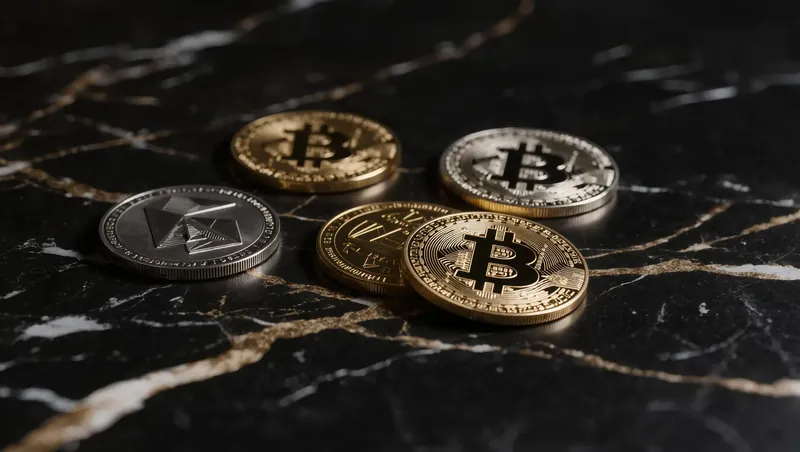
 AI illustration
Stablecoins are crypto-assets tied to a currency or another reference value; since 30 June 2024, issuers in the EU have had to hold reserves under MiCA, redeem at par at any time and pay no interest.
A stablecoin is a crypto-asset whose price is meant to be tied to something else, almost always an official currency. Regulation (EU) 2023/1114 of 31 May 2023, known as MiCA, sets out two categories: the e-money token under Article 3(1)(7), which references a single official currency, and the asset-referenced token under number 6, which points at other values or a combination of them. The promise sounds simple. It stands or falls with what sits behind the token.
Three designs, three promises
Fiat-backed stablecoins are the normal case. The issuer takes in money, puts out tokens of the same value and holds the money in deposits and short-dated paper. According to figures from the European Central Bank, the reserves of the two largest stablecoins as at 30 September 2025 consisted mainly of US government bonds, reverse repos, money market fund shares, cash and bank deposits.
Crypto-backed stablecoins pledge other crypto-assets, and more of them than the token is worth. This over-collateralisation is needed because the collateral itself moves. If it falls too fast, automatic liquidations kick in.
Algorithmic stablecoins hold no reserve and steer supply through rules and a second token. That is precisely the design that collapsed in May 2022. MiCA has no separate category for it: a token without sufficient reserves simply fails the requirements for e-money tokens or asset-referenced tokens.
How large the market is and what it is used for
The European Central Bank put the market capitalisation of all stablecoins in its Financial Stability Review of November 2025 at more than 280 billion US dollars, around 8 per cent of the entire crypto market. Two tokens denominated in US dollars dominate the field: Tether with 184 billion US dollars or 63 per cent, and USD Coin with 75 billion US dollars or 26 per cent. Two issuers therefore account for roughly 90 per cent of the amount in circulation.
Euro-denominated stablecoins, by contrast, are a marginal case. The ECB gives around 395 million euro for November 2025, a fraction of one per cent measured against the whole market. Roughly 99 per cent of the amount in circulation is denominated in US dollars.
Stablecoins are used above all in trading: about 80 per cent of all trades executed on centralised trading platforms worldwide run through a stablecoin, according to the same ECB report, as at November 2025. Everyday use is small. Only about 0.5 per cent of volumes are genuine retail-sized transfers, according to an analysis the ECB cites; those are amounts below 250 US dollars, with trades by programs and trading bots as well as internal transfers within a platform stripped out. The joint report by EBA and ESMA of 16 January 2025 adds that US dollar stablecoins accounted for more than 70 per cent of the total traded volume across all crypto-assets. Market forecasts that speak of 2 trillion US dollars by 2028 are quoted by the ECB as a third-party estimate, not as its own expectation.
What happened to TerraUSD in May 2022
TerraUSD was an algorithmic stablecoin. Its price was meant to stay stable through a second token called Luna, whose supply an algorithm steered in the opposite direction. In early May 2022 the relationship tipped over. The ECB describes in its Macroprudential Bulletin of July 2022 how Luna lost almost its entire market capitalisation in a sell-off and how the lending protocol in which TerraUSD was mainly used broke down in practice.
The effects did not stay inside one protocol. After the crash, the value locked in decentralised finance applications fell by almost 40 per cent, or 80 billion euro. The largest stablecoin at the time also came under pressure, temporarily lost its peg and saw outflows of more than 10 per cent of its market capitalisation.
The second case to learn from dates from March 2023. According to a footnote in the EBA and ESMA report, the second-largest stablecoin lost its peg when its issuer disclosed that it held 3.3 billion US dollars at the failed Silicon Valley Bank, about 8 per cent of its reserves at the time. Three days later the peg was back, after US authorities had said that the bank's creditors would be made whole. That is the core of issuer risk: the token is only as stable as the balance sheet behind it, and in an emergency it matters who else steps in.
The three types compared
| Feature | Fiat-backed | Crypto-backed | Algorithmic |
|---|---|---|---|
| Backing | deposits and short-dated paper | other crypto-assets, over-collateralised | no reserve, a rule set and a second token |
| Who is liable | the issuer | the protocol and its collateral | nobody with a balance sheet |
| Redemption | at par at any time and free of charge under Article 49 MiCA | liquidation of the collateral, depends on the price | no claim |
| Classification under MiCA | e-money token under Article 3(1)(7) | asset-referenced token under number 6, depending on the reference | fails the reserve requirements |
| Reserve duty in the EU | at least 30 per cent held as bank deposits | asset reserve under Article 36 | not a permitted design |
| Interest for holders | prohibited under Article 50 | prohibited under Article 40 | does not apply |
| Known event | loss of the peg in March 2023 after a bank failure | forced liquidations in sharp price falls | TerraUSD in May 2022 |
| Main risk | issuer and reserve | collapse in the price of the collateral, faults in the program code | loss of confidence, then total loss |
What MiCA has required since 30 June 2024
Article 149 of the regulation sets two dates: the rules for e-money tokens and asset-referenced tokens, that is Titles III and IV, have applied since 30 June 2024, everything else since 30 December 2024. The regulation applies across the European Union. Since that first date, issuers of such tokens in Germany have been supervised by BaFin, the German financial supervisory authority, while in other member states the national competent authority does the same job. On the supervisor's reading, e-money tokens may only be issued by electronic money institutions and CRR credit institutions.
Four duties matter for holders. First, under Article 49(3) the issuer puts out e-money tokens at the par value of the money received and, under paragraph 4, pays it back at par at any time, under paragraph 6 without a fee. Second, under Article 54 at least 30 per cent of the money received must sit in separate accounts at credit institutions, with the remainder in safe, liquid assets of the same currency. Third, Articles 40 and 50 prohibit any payment of interest, including through service providers and including covert forms through the pricing of other products. Fourth, under Article 39 holders of asset-referenced tokens have a permanent right of redemption, again free of charge.
What MiCA does not do: it does not turn a stablecoin into a deposit. There is no statutory deposit guarantee of 100,000 euro, and tokens issued outside the EU follow other rules. The ECB points expressly to the risk that a token is issued jointly in the EU and in a third country, and that the reserves supervised in the EU are then not enough for every redemption request. More on the timetable and on the duties of providers is in our piece on the MiCA regulation for investors.
How to check a stablecoin before you hold it
The Bank for International Settlements measures stablecoins in its Annual Economic Report 2025 against three tests: singleness, elasticity and integrity. It finds that they pass none of them and are therefore not suited to be a pillar of the monetary system, at most to play a subordinate part. On singleness the report notes that stablecoins often trade at differing prices. In practice this means: treat a stablecoin as a claim against an issuer, not as cash.
- Check in the supervisor's register whether the token is authorised in the EU and who issues it. Without authorisation there is no right of redemption under MiCA.
- Read in the crypto-asset white paper what the reserve consists of, how often it is audited and how quickly a redemption runs.
- Find out whether the issuer can freeze individual balances and on what conditions. Freezing single addresses is technically possible and belongs in the terms.
- Separate custody risk from issuer risk. If the token sits at a trading venue, its insolvency hits you with provider risk on top; the insolvency of 11 November 2022 shows how long such proceedings run.
- Expect that a stablecoin is not allowed to pay interest. Anyone offering you a running payment on the token inside the EU is running against Articles 40 and 50.
- Do not treat holding one as a tax-free ride. Swapping a coin for a stablecoin counts as a disposal. Look up unclear terms in the glossary.
How a stablecoin behaves alongside crypto-assets that move can be worked through in the portfolio mixer. How much of it fits your own situation at all is covered in the piece on the share of crypto in a portfolio. Why almost all stablecoins run on Ethereum is explained in the comparison of Ethereum and Bitcoin.
Frequently asked questions
Are stablecoins as safe as money in a bank account?
No. A stablecoin is a claim against an issuer, not a deposit. The statutory deposit guarantee of 100,000 euro per customer and institution does not apply. Since 30 June 2024 MiCA has required reserves, a right of redemption at par and at least 30 per cent in bank deposits, but it guarantees no value and replaces no guarantee scheme.
What happens when a stablecoin loses its peg?
The price falls below the reference value and everyone wants to redeem at the same time. In March 2023 it took three days for the second-largest stablecoin to regain its peg, after its issuer had to disclose 3.3 billion US dollars held at a failed bank; the peg only returned once US authorities promised that the bank's creditors would be made whole. With TerraUSD in May 2022 the peg never came back and the value was lost.
Am I allowed to receive interest on stablecoins?
Inside the EU, not from the issuer and not from the crypto-asset service provider. Articles 40 and 50 of Regulation (EU) 2023/1114 prohibit any payment tied to the length of holding, expressly including covert forms through the pricing of other products. Offers with running interest on a stablecoin therefore deserve a close look.
Why are there hardly any euro stablecoins?
Because demand in crypto trading points at the US dollar. The ECB put euro-denominated stablecoins at around 395 million euro in November 2025, while the whole market at the same date exceeded 280 billion US dollars and was about 99 per cent denominated in US dollars. Anyone who counts in euro carries an exchange rate risk on top with dollar tokens.
Are algorithmic stablecoins still allowed under MiCA?
There is no separate category for them. Anyone offering a token with a value peg to the public in the EU falls under the rules for e-money tokens or asset-referenced tokens, and both require a reserve and a right of redemption. A model without backing fails those requirements and therefore cannot be authorised.
Do I have to pay tax on stablecoin gains in Germany?
Swapping a coin into a stablecoin counts as a disposal and can trigger a private disposal transaction if less than a year lies between acquisition and swap. The stablecoin itself barely moves, but an exchange rate gain on dollar tokens is possible. For the details, the circular of the German Federal Ministry of Finance of 6 March 2025 applies. Rules outside Germany differ.
Sources
- Verordnung (EU) 2023/1114 über Märkte für Kryptowerte (MiCA), Artikel 3, 39, 40, 49, 50, 54 und 149Regulation (EU) 2023/1114 on markets in crypto-assets, Official Journal of the EU L 150 · 31 May 2023
- Stablecoins on the rise: still small in the euro area, but spillover risks loomEuropean Central Bank, Financial Stability Review · November 2025
- Decentralised finance: a new unregulated non-bank system?European Central Bank, Macroprudential Bulletin · July 2022
- Neue Spielregeln für einen neuen Markt: MiCAR in DeutschlandBaFin, the German financial supervisory authority, article on MiCAR in Germany · 1 July 2024
- The next-generation monetary and financial system, Annual Economic Report 2025, Chapter IIIBank for International Settlements · 2025
- Joint EBA and ESMA Report on recent developments in crypto-assets (Article 142 MiCA)EBA and ESMA · 16 January 2025