Security · From the houses
Trezor Clear Signing: read before you sign
Trezor has brought Clear Signing to its hardware wallets: supported smart contract transactions are decoded on the device and shown in plain language before you approve them. This piece explains the gap it closes, how it works and where its limits are.
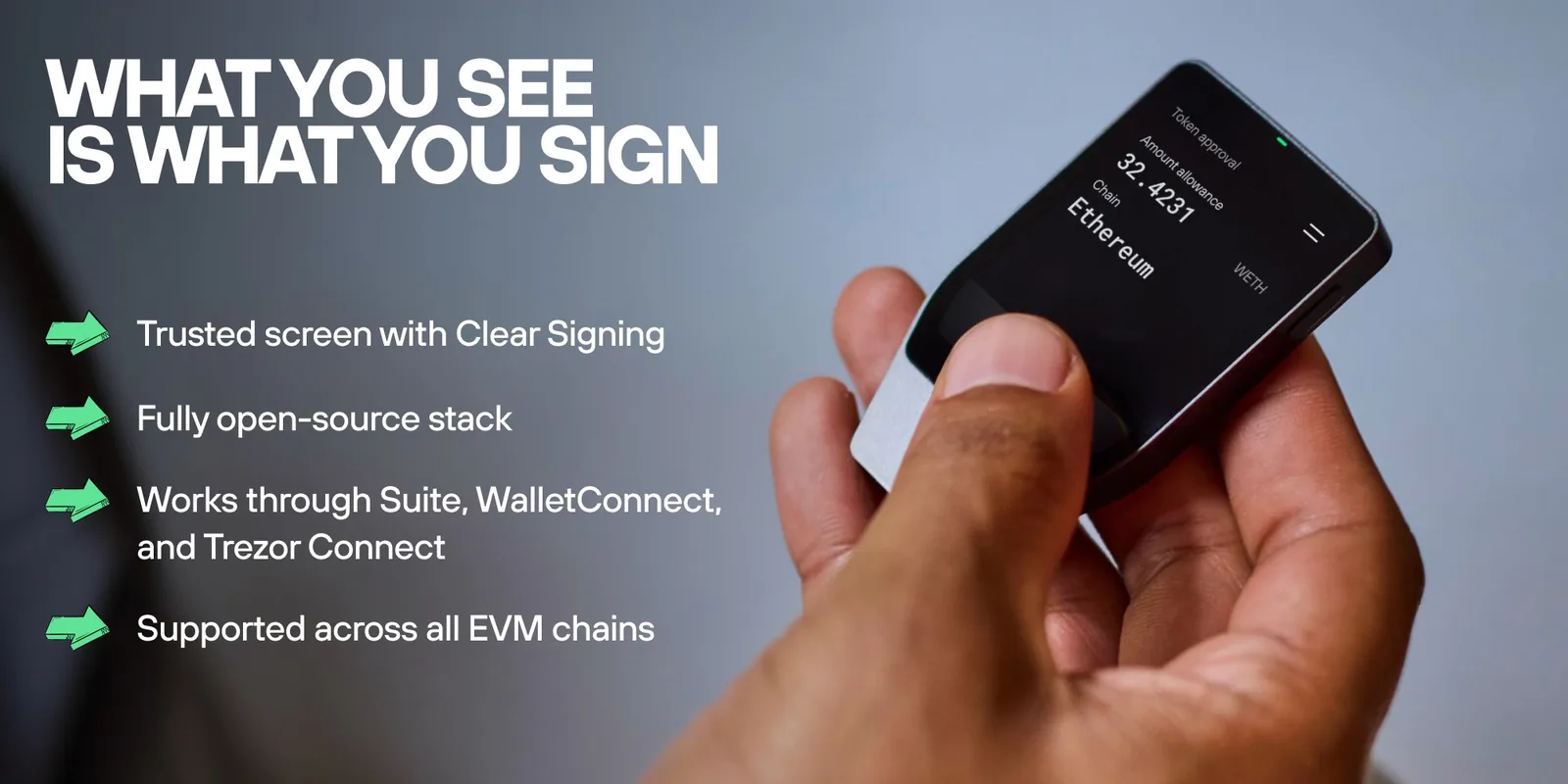 Photo: Trezor
- Provider: Trezor
- Feature: Clear Signing, introduced 7 September 2026
- Standard: ERC-7730 for Ethereum, layer 2 networks and EVM chains
- At launch: 1inch, Aave, Lido, Tether, LiFi, Hyperliquid and others
- Devices: Trezor Safe 7, Safe 5, Safe 3, Model T, not the Model One
- Works in Trezor Suite, via WalletConnect and Trezor Connect
Trezor introduced Clear Signing on 7 September 2026 and calls it its flagship security feature of the year. The idea is simple: when you approve a transaction with a smart contract or a decentralised application, the hardware wallet should tell you in plain language what you are about to sign, instead of showing a string of hexadecimal data.
The problem: blind signing
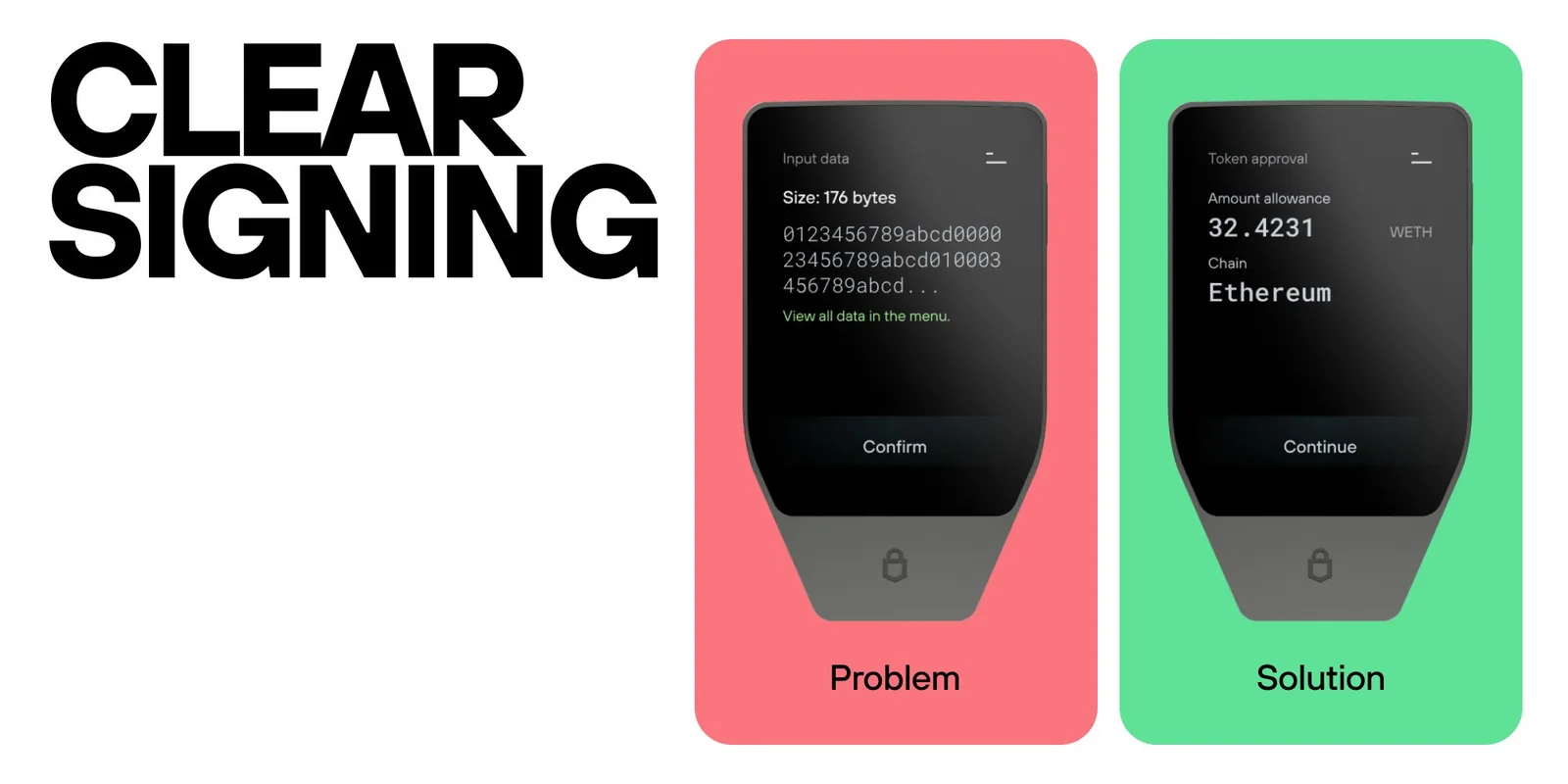
A hardware wallet protects the private key, signs offline and shows the transaction on its own trusted screen. With a simple transfer that works well, because amount and address are easy to check. With decentralised finance it broke down. The computer showed a readable description such as a swap of 2,000 USDC for ETH, while the device only received the encoded calldata and displayed it as a hash or a data preset. Users signed and had to trust that the computer was telling the truth, which turns the logic of a hardware wallet upside down. According to Trezor, this blind signing has cost many users their funds, and wallet drainers and compromised front ends exploit exactly this gap.
What Clear Signing changes
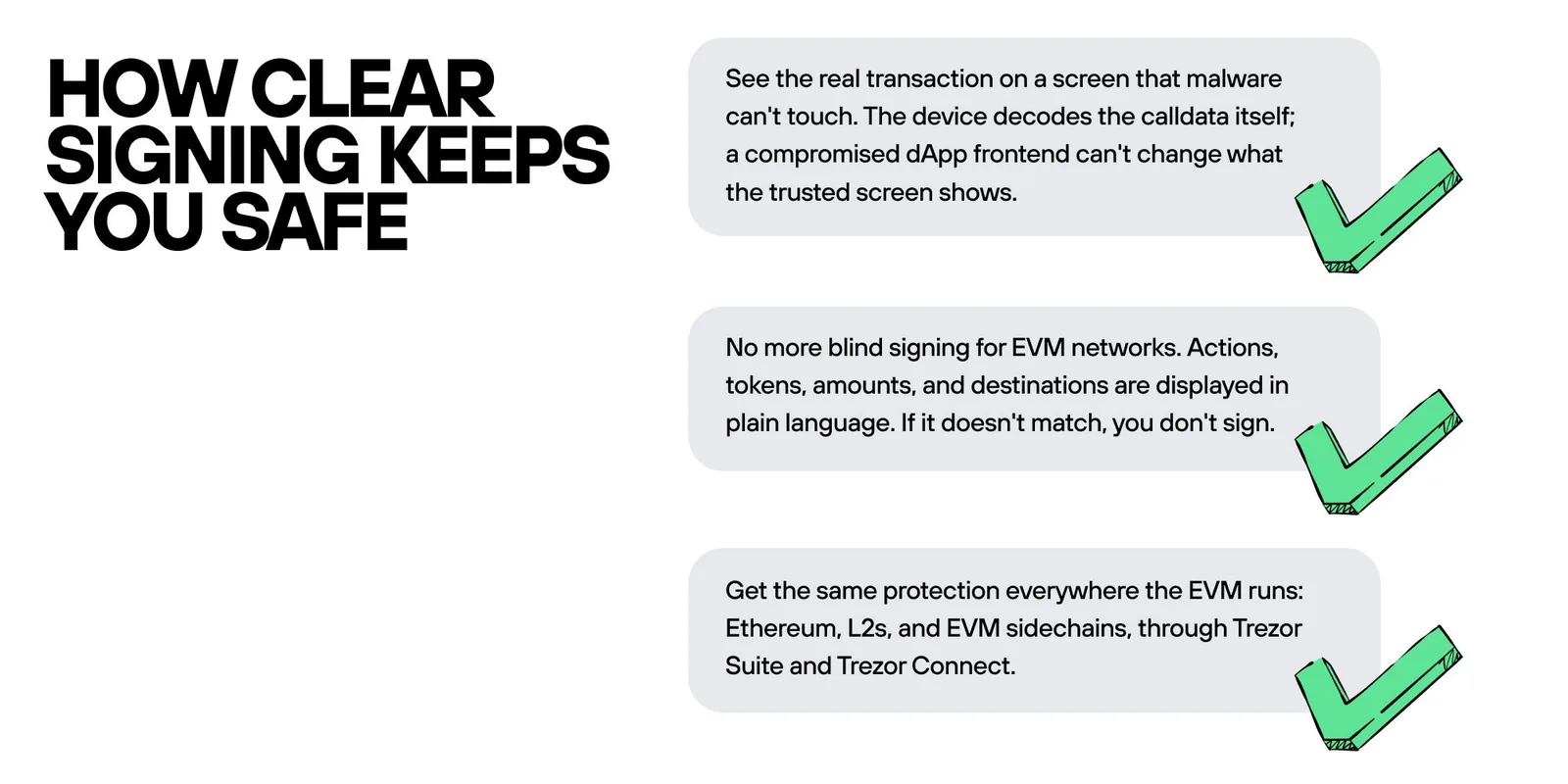
With Clear Signing the Trezor decodes supported transactions itself and shows the real action, the tokens, the amounts and the addresses on its screen. The device becomes the final source of truth again: whatever the computer claims, what you see on the Trezor is what you sign. If a contract is not supported yet, the device falls back to the standard blind signing warning.
Nothing new has to be installed or switched on. After a firmware update, Clear Signing works automatically in Trezor Suite, via WalletConnect and via Trezor Connect, and the usual workflow stays the same.
Which contracts and which devices
Coverage depends on the open standard ERC-7730, a registry of descriptors that tell a wallet how to turn smart contract data into readable details. It covers Ethereum, layer 2 networks and other EVM-compatible chains. A contract needs a supported ERC-7730 descriptor before the Trezor can decode it. At launch Trezor names major protocols including 1inch, Aave, Lido, Tether, LiFi and Hyperliquid, and says it is working on more networks.
Clear Signing runs on Trezor models with standard firmware that support Ethereum and EVM chains: the Trezor Safe 7, Safe 5, Safe 3 and Model T. The Model One does not get it.
Open source as part of the promise
Trezor stresses that its firmware is fully open source and that the Clear Signing stack follows the same rule: the ERC-7730 parsing, the decoding logic and the display pipeline can be inspected and audited by anyone, and the company encourages community audits. As more apps adopt the standard, coverage grows.
What it means in practice
Clear Signing closes a gap; it does not replace care. A readable screen only helps if you read it. Check the action, the amount and above all the receiving address before you confirm, and treat the blind signing warning as a stop sign rather than a formality. Our piece on hardware and software wallets explains where the key sits in each case, and the warning signs of crypto fraud describes the tricks that make people approve the wrong thing.
For anyone who uses DeFi with a hardware wallet, the update removes one of the most uncomfortable moments: approving something you cannot read. Because the standard is open, its value grows with every application that supports it.