Altcoins & DeFi · From the houses
Coinbase study: the dollar that never closes
Coinbase has published a study on how stablecoins are used to move dollars around the clock. The figures are striking, and the authors are open about their limits. This piece sums up what was measured and what is modelled.
 Photo: Coinbase
- Publisher: Coinbase, research by The Block Pro Research
- Published: 20 October 2026
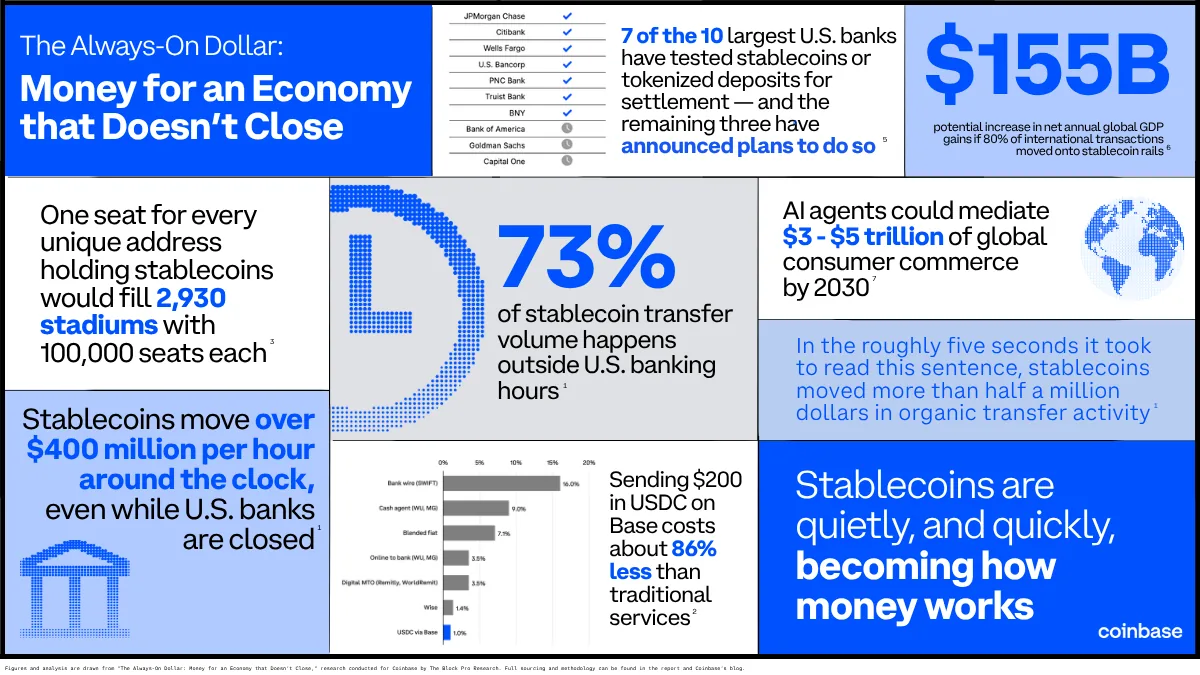
- More than 400 million dollars an hour moved via stablecoins
- 73 % of screened transfer volume outside US banking hours
- 293 million unique stablecoin addresses
- 891 billion dollars volume in Q3 2026
- Remittance of 200 dollars as USDC on Base: about 86 % cheaper
Banks close at night and at weekends; stablecoins do not. A study that Coinbase published on 20 October 2026 puts numbers on that difference. Titled The Always-On Dollar, it was conducted for Coinbase by The Block Pro Research and looks at how people and businesses use stablecoins, digital dollars on a blockchain, to move money when the traditional system is shut.
The headline figure
According to the study, people move more than 400 million dollars an hour through stablecoins. Of the screened transfer volume, 73 per cent took place outside US banking hours. Coinbase reads this two ways: stablecoins are an alternative while the classic rails are open, and a necessity when they are not. The underlying data come from Dune Analytics as of August 2026; transfers under one dollar, transfers to oneself and minting or burning are excluded, automated transactions are included.
Fees, addresses, volume
The study compares costs for a remittance of 200 dollars. Sent as USDC on the Base network, it is about 86 per cent cheaper than a traditional transfer, based on World Bank remittance prices and published fee schedules.
The number of unique stablecoin addresses has reached 293 million. The study sets this against the cardholders of American Express (155 million) and Discover (72 million) and against the 156.7 million mobile banking users of JPMorgan Chase, Bank of America, Wells Fargo and Citi combined. Coinbase itself points out the limit of the comparison: an address is not a person, so the figure shows the scale of adoption, not the number of users.
Transaction volume has more than quadrupled since the start of 2023 and reached 891 billion dollars in the third quarter of 2026, adjusted for bots and automated activity. If the current growth rate continues, the study expects around 1.5 trillion dollars per quarter by the end of 2027.
Banks and agents
Seven of the ten largest US banks have tested stablecoins or tokenised deposits for settlement, according to the study, and the remaining three have announced plans to do so. The authors also model the wider effect: moving 80 per cent of international transactions onto stablecoin rails could unlock 155 billion dollars in net annual global GDP gains. A further figure is taken from McKinsey: AI agents could mediate 3 to 5 trillion dollars of global consumer commerce by 2030. Coinbase calls this agentic finance and counts it among the drivers of the shift.
How to read the numbers
This is commissioned research, and the methodology note says so plainly: estimates and modelled scenarios describe potential outcomes, not results already achieved or forecasts, and the figures should be read in light of their periods, definitions and methods. The 155 billion dollars and the 1.5 trillion are models; the 400 million an hour, the 73 per cent and the 891 billion are measurements.
For readers new to the subject, our article on stablecoins and their risks covers how a stablecoin holds its peg and what happens if it does not. The study shows demand; it does not remove the issuer risk that comes with every stablecoin.